
Same Village, Different Scale
Imagine you are pregnant in Zanzibar. Every antenatal visit means hours in a hot, crowded waiting room, followed by a few rushed minutes with a clinician who is doing their best in a system that gives them almost no time or tools to do more. You leave with a stamp in your card, but rarely with the knowledge, support, or connection that would make you want to come back. Surrounded by women going through the same experience, you leave just as alone as you arrived, and when the next appointment comes around, it is harder to find the reason to return.
Now imagine it differently.
You walk into a room, and there is a circle of 8 to 15 women, all carrying what you are carrying. Over the next two hours, you receive the clinical care you came for, and you also get something the waiting room never offered: space to ask the questions you were too afraid to ask alone, and the quiet relief of not having to hold the emotional weight of pregnancy by yourself. Mental health support is not an add-on here–it is woven into every visit. At the center of it all are government-employed Nurse-Midwives and Mental Health Counselors, not rushing through a checklist, but leading a session they were trained and equipped to run. That is what we have been building toward.
April was one of our fullest months yet, and a reminder that getting there is not something we do alone.
Our Village Showed Up
In April, our partners did not just observe our work. They rolled up their sleeves and got into it with us.
Ben Kahrl from the Trotula Fund led our team through an Extreme Ownership session–a rigorous, honest look at how we take responsibility and accountability for our work, our gaps, and our growth. The kind of session that is uncomfortable in the best way–because real ownership is uncomfortable. It means no excuses, no finger-pointing, and no waiting for someone else to fix what is ours to fix. Extreme Ownership is now being woven into the DNA of how we operate as a team and into every training we deliver to clinicians because we believe that the Nurse-Midwives and the Mental Health Counselors who walk into that circle should carry that same standard–a deep, personal accountability for every single mama and child in their care. Not as a burden, but as a calling. Not as a checklist, but as a commitment.
Dr. Connie Mao from the Yang Jing Foundation brought something equally tangible: a cervical cancer screening and vaginitis training for our team and government-employed Nurse-Midwives from both embedding pilot sites–so that frontline healthcare workers can expand their scope of practice and better serve women, not just during pregnancy, but across their lives.
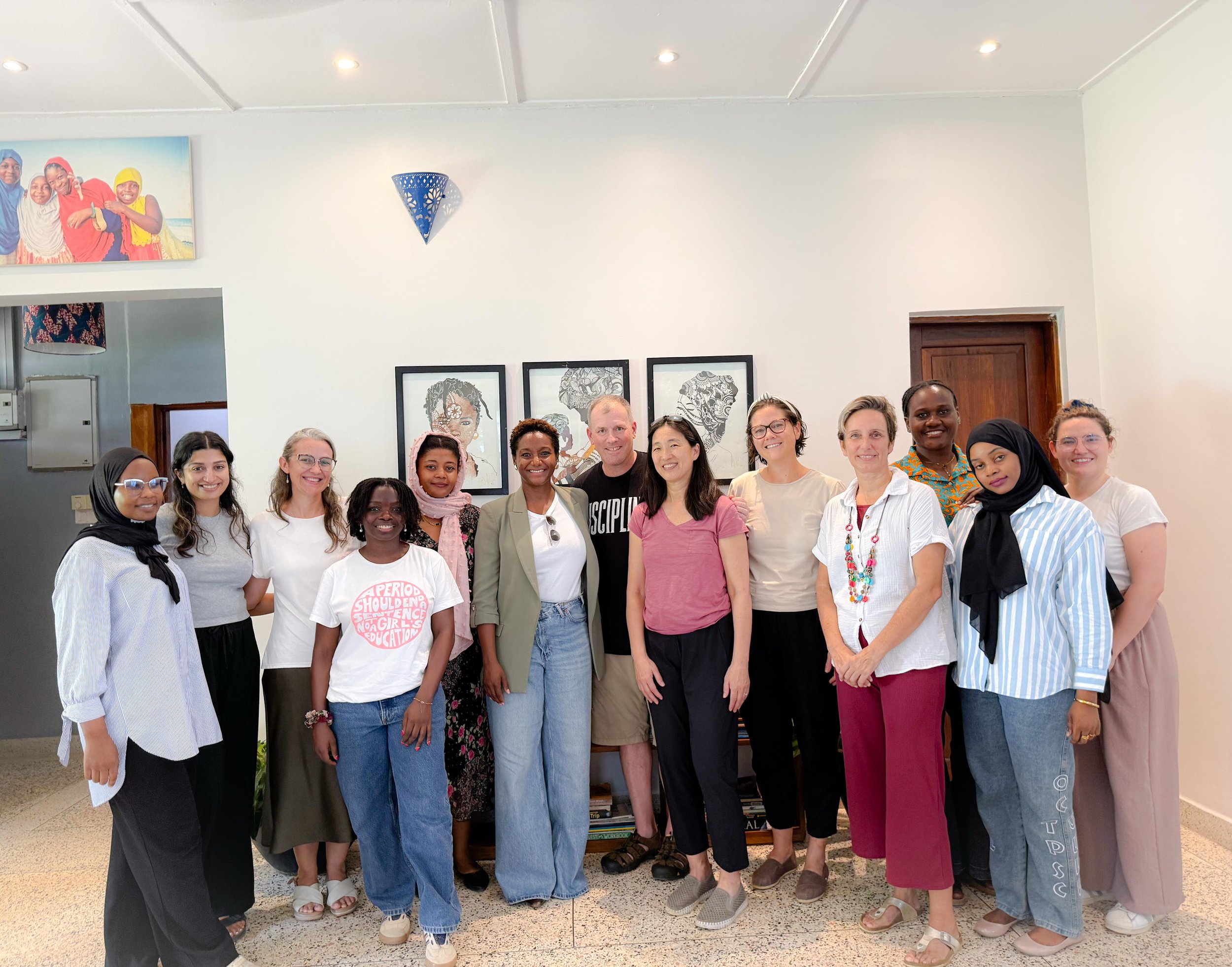
The WAJAMAMA team smiles with Dr. Connie Mao and Ben Kahrl after a productive week of trainings together.
Amit and Eliguard from Dovetail Impact Foundation did not just visit, they embedded with us. They reviewed and strengthened our M&E tools, dug into our financial and reporting strategies, and sat with us through the hard conversations that come with navigating a critical phase of growth. They came as thought partners and left as part of the story. That kind of hands-on, shoulder-to-shoulder support is rare, and we do not take it for granted.
UNICEF, the Ministry of Health ICT team, CareNX, and our team gathered for a ZanEMR Fetosense integration workshop–a critical step before we go live at Group Care facilities. Fetosense is a portable cardiotocography (CTG) machine, making fetal and contraction monitoring possible for the first time in Zanzibar's healthcare system. We believe CTG monitoring has the power to save lives at a scale we have not yet seen here. It will make non-stress tests for high-risk mothers accessible during pregnancy for the first time, becoming a core part of GCM so that babies at risk are identified early, and intervention can happen promptly. But technology is only as powerful as the systems around it. This workshop ensured that the data Fetosense captures feeds directly into ZanEMR and back, with key stakeholders aligned before the switch is flipped.
Spring Impact returned for four intensive days to help us look honestly at the embedding pilot–what is working, where teams are struggling, and what we could not have known until we were deep inside it. Together, we mapped six priority solutions that will shape our next phase, designed a model for how our role evolves as Group Care moves from pilot to government-owned system, and got clear on exactly who we need on our workforce to climb this mountain. Because the right strategy without the right people is just a plan on paper.
Different partners. Different expertise. All pointing in the same direction.
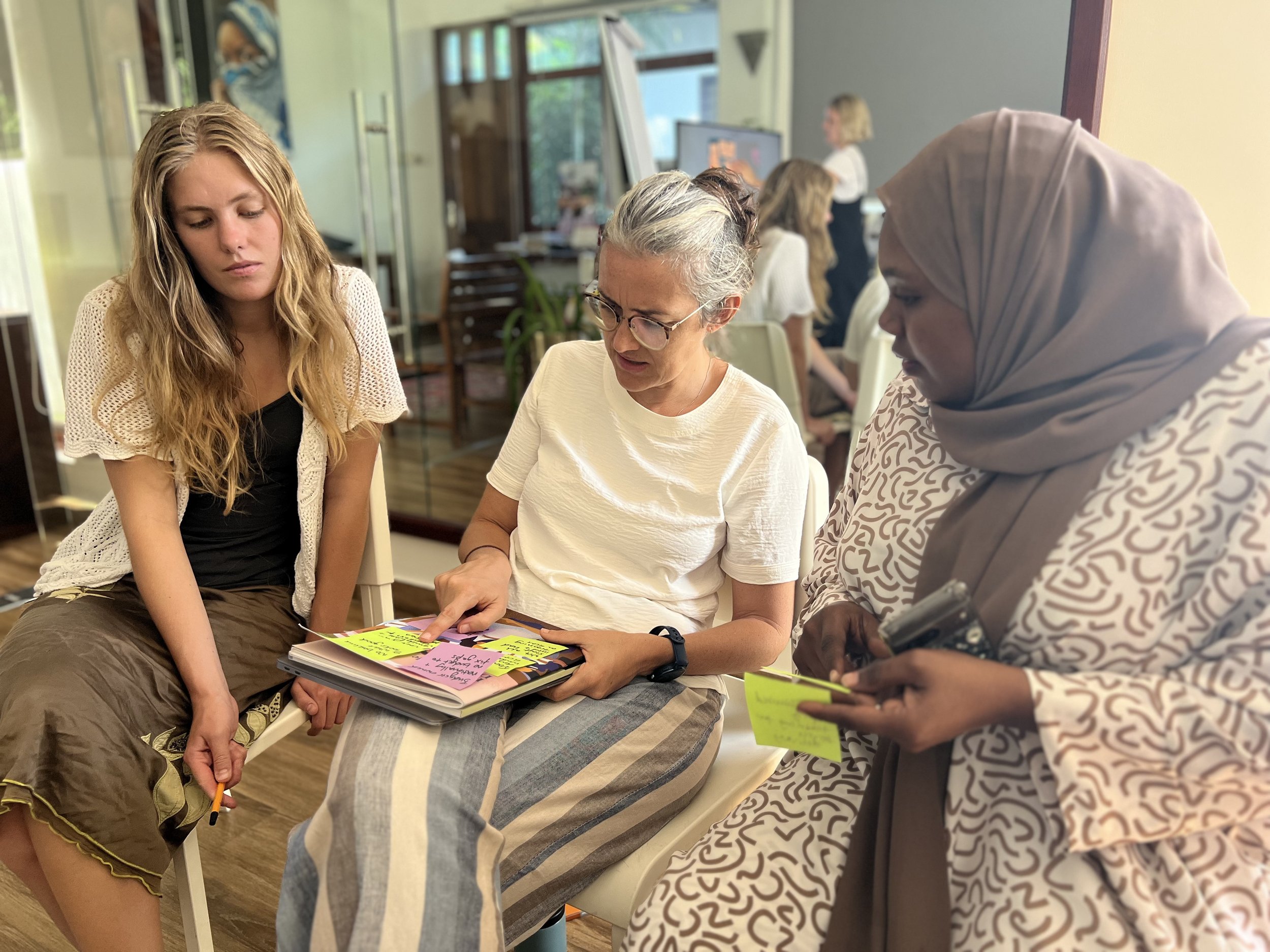
WAJAMAMA team members work with Spring Impact to map pilot challenges by their impact on GCM delivery.
It Takes a Community
WAJAMAMA was born from a painful observation: that in a place where community is woven into everything, pregnancy had become a solitary experience. Group Care was the answer — restoring what pregnancy was always meant to have around it.
Building the system to sustain that care demands the same village. None of what you have followed this year happened without one.
We still have a long way to go. But we have never been more certain of how to get there, or more grateful for who is making the climb with us.
We are building something that believes in community. It makes sense that the community is what is building it.
With love and light,
The WAJAMAMA Team